May 19, 2026
Rev. Eugene Cho Challenges Us to See People, Love Boldly, and Show Up for Each Other
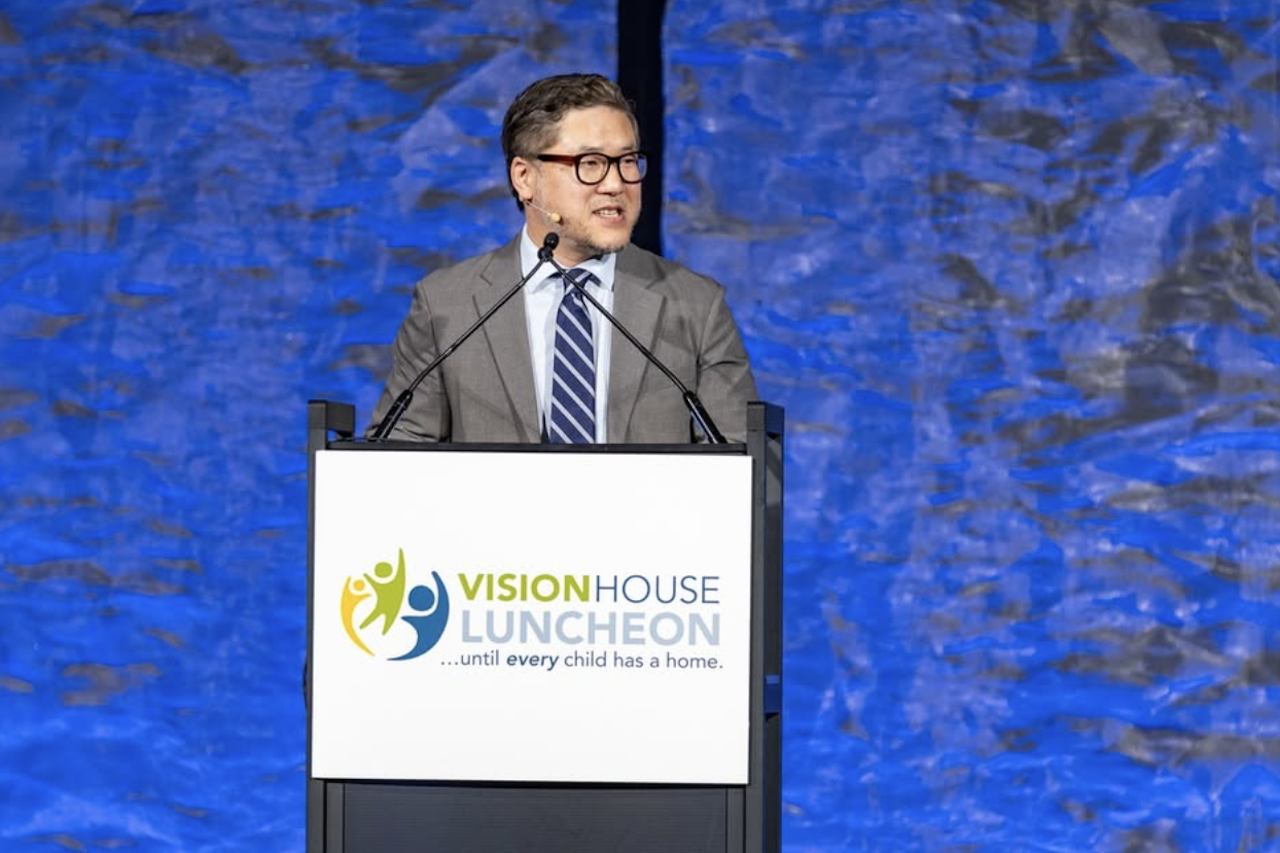
Vision House just held our annual luncheon, an event to raise funds and awareness towards ending homelessness in the Seattle metro area. If you attended this year, you probably walked away inspired by Rev. Eugene Cho’s keynote.
Rev. Eugene Cho is the President and CEO of Bread for the World. Before stepping into national leadership, he pastored local churches for nearly 30 years, a foundation that continues to shape his approach to advocacy and justice.
An award-winning author, Rev. Cho holds various leadership roles focused on hunger, nutrition, and poverty. He is also the founder of One Day’s Wages, an organization raising awareness of extreme global poverty and mobilizing people to respond.
Mobilizing people is exactly what he did at our luncheon. He reminded us not to grow weary. He challenged us to see people, love boldly, and show up for each other.
If you weren’t there, we’ve provided the text below.
VISION HOUSE KEYNOTE: MAY 5, 2026
For those of you I haven’t met, my name is Eugene Cho, and I serve as the President of Bread for the World—a national advocacy organization working to end hunger in the United States and around the world.
Which basically means I spend a lot of time in Washington, D.C.
Talking. Meetings. More talking. Briefings. PowerPoints.
And sometimes people ask me, “So, what do you actually do?”
And I tell them: I try to convince people with power to care about people without it.
Some days that feels inspiring.
Other days…it feels like trying to explain TikTok or AI to my parents. In other words, it feels exhausting.
But here’s what I’ve learned:
Policies matter. Advocacy matters.
But if that’s all we do—and we neglect what’s happening on the ground, at the local level—then we’ve missed something essential. In other words, we have to connect the dots and by dots, I’m talking about change in real people, in real circumstances…towards a more flourishing future.
Because change doesn’t just happen in legislation.
It happens in living rooms.
In kitchens and dining tables. In schools. In churches.
In places like Vision House.
Right here.
And that’s why today matters.
Today, I want to encourage, invite, and challenge us with three thoughts for your consideration. Three things that I truly believe can make a difference.
Point 1: The Power of Being Seen
This might sound naive and as if I’m contradicting myself. Food, shelter, medicine, etc., are all so important but I believe there is something even more foundational to human flourishing: It is the power of being seen.
- To be recognized.
- To be valued.
- To be treated as fully human.
And if we’re honest, homelessness has a way of making people invisible.
We walk past families in crisis.
We avert our eyes.
We grow numb.
As Mother Teresa once said: “The most terrible poverty is loneliness and the feeling of being unloved.”
Human beings become scenery.
Families become statistics.
Children become part of “the problem.”
They become points or notches to fit our narratives or political talking points that pundits hurl back and forth.
This is what Vision House is all about.
Vision House refuses that reduction.
Because Vision House sees what many overlook.
They see not a case file—but a child.
Not a burden—but a mother carrying impossible stress.
Not a failure—but a father trying to hold dignity together.
And that matters.
Because language shapes imagination.
And imagination shapes action.
When we call people “problems” we distance ourselves.
When we reduce people to projects, we dehumanize people and God did not intend people to become projects.
But when we call people neighbors… families… beloved children of God…Imago Dei.
That’s what Vision House offers:
Attention.
Dignity.
Presence.
It says:
We see you. You matter. Your children matter.
And sometimes the first step toward transformation…
is simply being seen.
Point 2: Hope and Cynicism
Now, let’s be honest.
The problem of homelessness can feel overwhelming.
We hear the numbers or see the images:
- 14 million people facing food insecurity in the U.S.
- Nearly 1 in 5 households with children in King County facing food insecurity
- 36.8% of single-mother households at highest risk
- Over 4,000 students in King County experiencing housing instability
- More than 41,000 students in Washington State experiencing homelessness in a single school year
And slowly, subtly… cynicism creeps in.
That voice that whispers:
- “This is too big.”
- “What difference does this really make?”
- “They deserve to be homeless.”
- “This is a waste of time or money.”
- “I’m fed up.”
Cynicism feels like wisdom.
But it’s not.
It’s surrender.
The theologian Cornel West puts it this way:
“Justice is what love looks like in public.”
And love—real love—does not surrender to cynicism.
Yes, it’s hard and messy, but it doesn’t give up.
Because here’s the blunt truth:
We can’t fix everything. Anyone or any organization that says that we can change the entire world is selling us something.
We can’t fix everything. We can’t change the entire world. We can’t change all of Washington. We can’t change all of Seattle. We may never fix all the traffic in Seattle (Sorry, too soon?).
We can’t change everything…but we can change/impact the world of some.
You’ve heard some incredible, significant statistics and numbers.
But for a child—
One stable home changes everything.
For a family—
One year of support can break a generational cycle.
And Scripture reminds us (Galatians 6:9):
“Let us not grow weary in doing good…”
Why?
Because we do grow weary.
Because this work is hard.
But the call is clear:
Do not give up.
And friends, the best part of being hope and light, the best part of wanting to change the world, is that we get changed in the process. And if we’re honest: We need to be changed too.
We become more tender. We become more human. We become more hopeful. More connected. More neighborly. We become more as God intended us to be. We become more alive.
Point 3: The Power of Action
We live in a time where it’s easier than ever to appear engaged…
Without actually being engaged.
We can post. Like. Comment.
We can care… briefly.
But if we’re not careful, complexity leads to paralysis.
“If I can’t do everything, I’ll do nothing.”
“If we can’t fix everything, I’d rather not do anything.”
“If it’s not perfect, I don’t want to be a part of it.”
But Vision House shows us another way.
It shows up. It builds relationships. It builds trust.
It asks hard questions. It comes alongside. It walks with people.
It shows up…and keeps showing up…and keeps showing up.
Because this is what action looks like:
- About 90% of the families who live at Vision House for a year and go through a program move on to stable, permanent housing.
- Vision House helps 1000 families a year in some way, whether it is the one occasion of receiving food, a shower and support in our service center, or ongoing counseling, and care.
That’s not theory.
That’s transformation.
James 2:26: “Faith without work is dead…”
That’s what’s happening here.
Not grand gestures.
But faithful presence.
Real impact.
Vision House doesn’t just interrupt homelessness.
It disrupts the cycle. That’s the vision. That’s the imagination.
It steps into instability and says:
“This is not the end of your story.”
That’s the power of action.
Closing Invitation
What an opportunity to reject cynicism and be people of hope.
What an opportunity to see people.
What an opportunity to be people of action.
You are helping a child sleep safely.
You are helping a parent breathe again.
You are restoring dignity.
So let us not grow weary.
Let us not give up.
Let us continue to show up.
To see people.
To love boldly.
To give generously.
Because transformation is happening.
Right here.
Through Vision House.
Thank you and God bless you.


